 Fasti
Fasti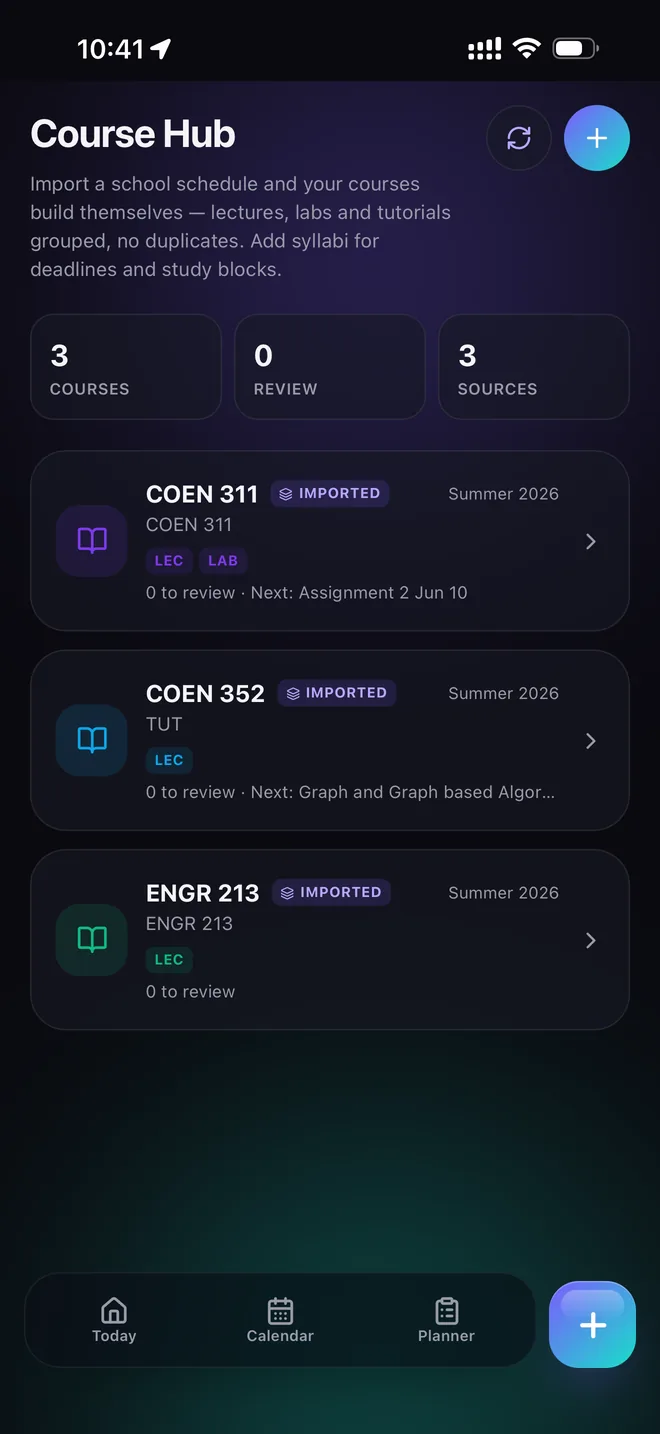
Step 1 — Import your timetable first
Everything else in a semester plan is built around your fixed class times, so that's where planning starts. Import your class schedule from whatever format your school gives you — screenshot, PDF, or a portal you'd otherwise have to keep reopening — so lectures, labs and tutorials are on your calendar with their real recurrence, including rotating weeks or short lab terms.
Step 2 — Map every deadline from your syllabi
With your fixed schedule in place, go through each course outline and add every exam, assignment, project and quiz date. Do this for every class in the first week, not one syllabus at a time as the semester goes on — the whole point is seeing all of it at once, so a project due the same week as two exams shows up in September, not the night before. The syllabus-to-calendar tool can extract these dates from a PDF or photo for you to review.
Step 3 — Block study time around what's fixed
Once your classes and deadlines are both visible, place study sessions in the space that's actually left — not in an idealized empty week. Give each session a specific purpose tied to a specific deadline, and start preparation days or weeks before it's due. The study planner guide covers how to size and place these sessions realistically.
Step 4 — Fit work and life around the plan, not instead of it
Work shifts, commute time and social plans should be added against this same calendar, so a shift request or an evening out is judged against what's actually already there. See the student schedule planner guide for keeping all of it in one week.
Step 5 — Review weekly and adjust before it's urgent
A semester plan made in week one will need adjusting — an extension here, an added assignment there, a shift that changes. A short weekly review, checking the week ahead for anything that no longer fits, is what keeps the plan accurate for sixteen weeks instead of falling apart by week four. See how to stay organized in college for the full weekly habit.
Use a simple semester planning template
Keep the plan useful by giving each item a job: fixed events are the structure, deadlines are the destination, and study blocks are the route between them. A practical semester planning template has four layers:
- Fixed time: classes, labs, work shifts, commute and recurring appointments.
- Important dates: exams, assignments, projects, quizzes and registration deadlines.
- Preparation: study sessions and smaller milestones placed before each deadline.
- Weekly review: a short check that moves what no longer fits and protects the next priority.
That order prevents the common mistake of filling a calendar with tasks before checking whether the fixed week has room for them.
Common questions
When should I start planning my semester?
In the first few days of the term, before the reading and assignments pile up. Planning early means you're working from a complete picture of every deadline, not reacting to whichever one comes up next.
What's the first thing to do when planning a semester?
Import your class timetable so every lecture, lab and tutorial is on your calendar. That fixed structure is what everything else — study time, work shifts, deadlines — gets planned around.
How far ahead should I plan study time for exams?
As soon as the exam date is confirmed, even if it's months away. You don't need a detailed plan that early, but placing a placeholder means you won't discover the conflict with another deadline at the last minute.
How often should I revisit my semester plan?
Weekly. A semester plan made in week one will inevitably need small adjustments as the term goes on — extensions, added assignments, shift changes — and a short weekly review is what keeps it accurate instead of stale.